
When Consumers Stop Searching for Products
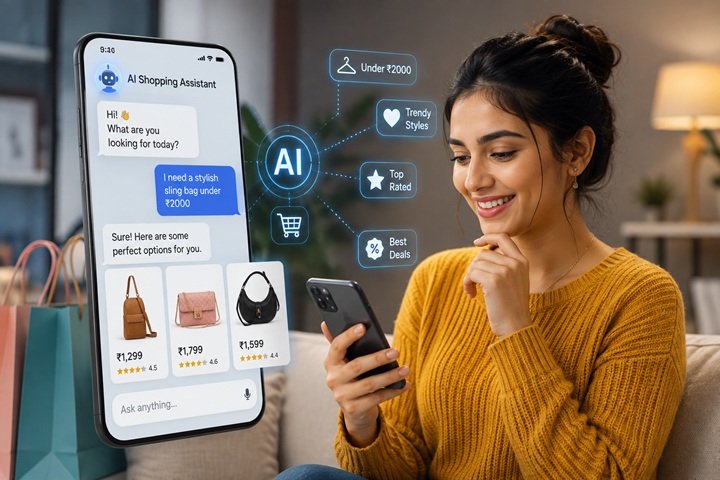
AI-assisted shopping
Search has traditionally given retailers a clear place to compete: keywords, rankings, ads and product pages. But as consumers increasingly use different platforms to research and compare products, the discovery process could become less about where a product appears and more about whether a system considers it relevant enough to recommend.
For two decades, discovery meant typing a query into a search bar and scrolling through results. That habit is breaking faster than most retailers have noticed and the replacement isn’t a better search engine. It’s no search at all.
Ask someone in retail what “discovery” means and they’ll usually describe some version of the same funnel: a customer types a query, scans a page of results, clicks through a few links, compares tabs, and eventually lands on a product. That model powered two decades of SEO budgets, paid search strategy, and product-listing optimisation.
It’s starting to come apart. Not because search engines got worse, but because a growing number of shoppers have stopped opening them in the first place. They’re asking an AI assistant instead and increasingly, letting it do the comparing, shortlisting, and sometimes the buying too.
The habit is changing faster than the infrastructure around it
The clearest evidence isn’t a prediction, it’s already showing up in traffic logs. Adobe Analytics, which tracks purchase data across more than a trillion visits to U.S. retail sites, found that AI-referred traffic to retail sites was up 693% year-over-year during the 2025 holiday season, with November alone up 769% and December up 673%. That surge came with a shift in what the traffic was actually worth: AI referrals converted 31% more than other traffic sources during the holiday season, nearly doubling year-over-year a genuine reversal from just months earlier, when AI traffic was still converting 23% lower than non-AI traffic in July 2025. By October 2025, AI-referred visitors were converting 16% more than non-AI traffic, following a 5% edge the month before. The gap didn’t just close. It flipped.
That shift lines up with what consumers themselves report. A global study by the IBM Institute for Business Value, run with the National Retail Federation across more than 18,000 consumers in 23 countries, found that almost half of shoppers (45%) now turn to AI at some point during their buying journey using it to research products, interpret reviews, and hunt for deals. Notably, the same study found nearly three-quarters of consumers (72%) still shop in physical stores, which is a useful reminder that this isn’t a story about stores disappearing. It’s a story about what happens before the store, or the checkout page, ever enters the picture.
From search results to a single answer
The mechanics of this shift are becoming concrete. OpenAI launched ChatGPT Shopping Research in November 2025, and by early 2026 the company’s own data showed the feature was handling roughly 50 million shopping-related queries a day a small share of ChatGPT’s overall traffic, but a real and fast-growing one, running across a user base that OpenAI put at 900 million weekly active users in February 2026. Amazon has moved even further: its AI assistant (originally called Rufus, folded into “Alexa for Shopping” in May 2026) was used by more than 300 million customers in 2025, according to the company’s own Q4 earnings disclosure, and Amazon has said shoppers who engage with it are about 60% more likely to complete a purchase than those who don’t.
What connects these numbers isn’t just adoption it’s what the interaction actually looks like. Instead of ten blue links, a shopper gets a single conversational answer, often with a shortlist already narrowed down. McKinsey’s research team, which has studied this shift closely, estimates that AI agents mediating purchases directly could account for $3 trillion to $5 trillion of global consumer commerce by 2030, even under what it calls a moderate scenario. That’s not a forecast about search getting smarter. It’s a forecast about search getting skipped.
The Indian market is moving ahead of the curve, not behind it
This isn’t only a U.S. story, and for a market like India, the numbers suggest the shift may be arriving faster than in the West, not slower. Accenture’s Consumer Pulse Survey 2026, covering more than 25,000 consumers across 16 countries, found that 41.4% of Indian respondents now turn to AI before search engines when looking for information online, and 94% said they would like to shop directly within generative AI tools. A separate YouGov study conducted in India between April and May 2026 found that three in five Indian online searchers (60%) now begin at least one new search a day with an AI assistant, and 89% use AI assistants in some capacity when searching for information. Adobe’s own India-specific findings, part of its 2026 AI and Digital Trends Report, showed 65% of Indian consumers already use AI to find personalised product recommendations, with India recording the highest consumer interest in agentic AI anywhere in the Asia-Pacific region.
Put plainly: in a market retailers have long treated as a search-and-marketplace economy, a meaningful share of shoppers are already choosing not to search at all.
What this actually changes for a retailer
None of this means a brand’s website stops mattering. It means the traffic arriving there is starting to come from somewhere other than a results page, shaped by a conversation the retailer had no part in. When an AI assistant is the one narrowing five products down to two, the product page a shopper eventually lands on isn’t where the decision got made it’s where the decision gets confirmed, or completed. Product data, pricing accuracy, and review clarity now do double duty: they still have to convince a human, but they also have to be legible enough for a system to read, compare, and trust in the first place.
The uncomfortable part for retailers is that this shift rewards infrastructure over marketing spend. A search ranking can be bought. Being cited correctly by an AI system, consistently, cannot at least not yet. That gap is where the next competitive advantage in retail is likely to be decided.
At BIGBOX, we track how discovery, commerce, and AI are converging across Middle Africa, India and South East Asia, connecting retail and e-commerce leaders to the data and strategies shaping what comes next.
To know more about our upcoming BIGBOX Event: https://www.bigboxmedia.net/upcoming-events/