
The Consumer Is No Longer Following Your Funnel. Is Your Retail Strategy Keeping Up?
From social discovery to AI-assisted decisions and messaging-led purchases, consumers are taking increasingly unpredictable paths to the checkout. Retailers may need to rethink how they measure and influence the journey.
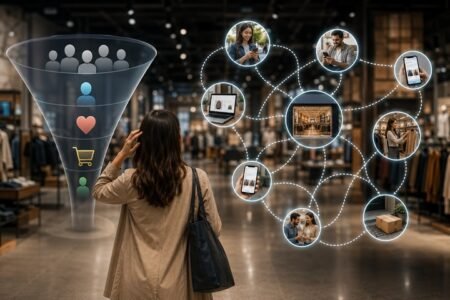
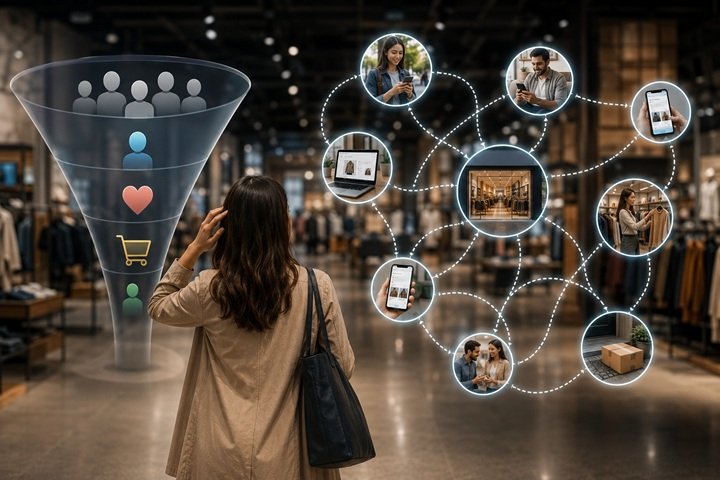
The retail funnel assumes a simple sequence: awareness, consideration, purchase. Shopping behaviour no longer fits that order. A consumer may discover a product on social media, research it through search, compare prices on a marketplace, ask friends for recommendations, and buy it through an app. Another may see a product in-store before researching and purchasing it online. Increasingly, AI enters the process too helping consumers discover, compare, and decide before a retailer ever sees a click.
The transaction is still measurable. The journey behind it is not.
From a linear journey to connected commerce
Digital commerce has layered marketplaces, social platforms, apps, messaging, and recommendation systems onto an already complex retail landscape, without physical stores stepping aside. BCG’s February 2026 report, $300 Billion Connected Commerce, describes this as a shift toward “connected commerce,” where online and offline retail increasingly co-exist through a single consumer journey rather than competing channels. The report is based on a survey of more than 12,000 consumers across urban and rural India and finds that five out of ten offline shoppers still research online before buying.
A purchase made on an e-commerce platform may have been shaped by a social post viewed days earlier. A store visit may end in an online order. The transaction leaves a record; the influence behind it often doesn’t.
Retailers track clicks, impressions, conversion rates, and acquisition costs with real precision but none of it fully explains the decision. But good tracking doesn’t mean the full picture. A consumer who sees a product on social media, searches for it days later, reads reviews, and buys it on a marketplace. Four different platforms, four different partial records and the review, often the most persuasive input, which probably mattered most, usually leave no trace in anyone’s dashboard. This is where the funnel becomes a partial picture: it shows progression but struggles with the non-linear interplay between touchpoints. The relevant question is shifting from where did the sale happen to what contributed to the decision.
AI is adding another layer to discovery
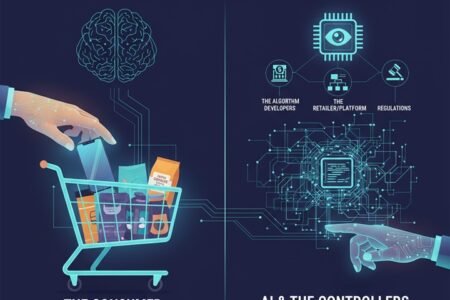
AI is accelerating this shift, especially in this region. Visa’s 2026 State of Digital Commerce in Asia Pacific study, covering 14 markets and more than 14,000 consumers, found that 74% of consumers across Asia Pacific are already using AI-powered tools to discover, track, or learn about products. Deloitte’s March 2026 report, The Future of Commerce: Agentic Shopping in Asia Pacific, points the same way almost three-quarters of Asia Pacific consumers are already using AI to discover and compare products, and nine in ten retail executives expect AI to be used more than traditional search engines by 2026, while half expect today’s multi-step shopping journey to collapse by 2027.
That’s a real shift in where the competition is happening. Retailers have spent years to optimise for visibility in search results. Soon, the next competition may increasingly be for a place in the consideration set an AI system builds on a shopper’s behalf, which actually raises the stakes on clean, accurate product data, pricing and reviews rather than lowering them. And it leaves an uncomfortable question hanging: how does a retailer build preference when the first recommendation comes from a machine rather than a search page?
Retailers have responded by expanding into social commerce, marketplaces, apps, messaging, quick commerce, and loyalty platforms — everywhere the consumer might be. But being present across channels isn’t the same as connecting them. A customer doesn’t distinguish between the e-commerce team, retail team, and customer service. They see one brand. The next challenge may be less about adding a touchpoint and more about understanding how the existing ones work together.
The answer isn’t to abandon the funnel — it’s to recognise what it can’t tell you alone. Awareness, consideration, and conversion remain measurable. What’s missing is the connective tissue: where a customer first encountered a product, what prompted deeper investigation, which information tipped the decision, and what brought them back.
The funnel may not disappear. It may simply become harder to see. Consumers move between platforms, compare, pause, return, and increasingly let AI help make sense of it all. The task ahead isn’t predicting every move, it’s understanding what role each interaction plays when the path itself can’t be predicted. Because the decisions happening between the clicks might end up mattering just as much as the click that finally turns into a sale.
At BIGBOX, we track and unpack these shifts, connecting retail and e-commerce leaders across Middle Africa, India and South East Asia to the strategies, data, and technologies reshaping how consumers actually buy.